
In May 2024, my employer the Bay Area Reporter was approached by the American Middle East Press Association with the offer to send a reporter to Israel to cover the Israel-Hamas War in Gaza. I decided to go, and went to Tel Aviv, both East and West Jerusalem, the border of Lebanon, and the sites of Hamas massacres on Oct. 7, 2023, among other sites, in June, followed by a series of stories on the war and related issues in the broader Israeli-Palestinian conflict. I made sure to speak to both Israelis and Palestinians and in the roughly 10,000 words of reporting that followed, to write and quote from both in about equal measure.
The first story, “Debate over pinkwashing claims spur strong feelings in Israel, US,” was published July 17, and focused on the state of LGBTQ rights in Israel and the Palestinian territories and the role the queer community has played in the debates over the war and the post-1967 Israeli occupation of the West Bank and Gaza Strip. The second, “New press group invited B.A.R. to Israel,” published the same day, discussed what AMEPA is (specifically, that it’s not funded by government agencies).

The third, “Palestinians seek accountability, statehood,” was published July 24, and focused on the aspirations and the plight of the Palestinian people, including the perspective of a longtime poet and human rights lawyer, a website with the testimonies of LGBTQ people in the Gaza Strip, and a Bay Area man who grew up in Gaza City and is working for peace in the aftermath of immense personal loss.
The fourth, “United against Hamas, Israelis differ in opinions on Gaza war, Netanyahu,” was published July 31, and focused on the Oct. 7 pogrom in Israel, the hostage crisis that precipitated the war, the U.S. campus protests against Israel and disagreements between the U.S. and Israeli governments on West Bank settlements.
I hope you find these stories aligned with the principles of journalism at their best, with the honest pursuit of the truth, and an earnest desire to see the complexity of a tragic situation.
Debate over pinkwashing claims spur strong feelings in Israel, US
Since October 7, 2023, the Israeli-Hamas war has brought the Israeli-Palestinian conflict to the center of the world’s attention.
In the LGBTQ community, it’s focused renewed attention on the accusation that Israel engages in pinkwashing. Pride parades in New York, Boston, and Toronto last month were disrupted by protesters alleging Israel uses LGBTQ rights to deflect from its policies toward Palestinians.
Pinkwashing is the promotion of the pro-LGBTQ aspects of a corporation, political group, or government in order to downplay other things that might be considered negative. Corporations that participate in Pride but donate to anti-LGBTQ politicians are often accused of it, as is Israel.
In San Francisco, pro-Palestinian groups boycotted the June 30 Pride parade, drawing between 1,000 to 1,500 people to a countermarch through the city’s Mission and Castro neighborhoods.
Rauda Morcos, a lesbian Palestinian citizen of Israel who’s a human rights lawyer, told the Bay Area Reporter in a Signal interview that she thinks Israel uses the issue so Westerners will look the other way from the occupation of Palestinian land. She was one of the founders of Aswat, a group for Palestinian lesbians.
“Israel has no right to use their notion of being LGBT-friendly, or their idea of being LGBT-friendly, that would allow them to be supremacists in the region. It would never give them an extra benefit to make them a democratic country,” she said. “You can’t call apartheid and occupation democratic, or LGBT-friendly.”
In turn, Israeli LGBTQs with whom the B.A.R. spoke on a recent press trip to the region were surprised at the level of anti-Israel sentiment in the global queer community since October 7 — and asked American activists to compare Israel’s record against that of their opponents.
“If you’re talking about Hamas, you’re talking about a jihadi organization,” longtime Israeli gay activist Rommey Hassman said in an interview. “Jihadi organizations are against homosexuality. They define us as something not even illegal but demonic. They think all gay men should be executed. That is not something new. They are not progressive and [are] anti-anything LGBTQ. It’s like saying ‘Black people for the KKK.'”
The June 23-27 trip in which the B.A.R. participated was paid for by the American Middle East Press Association, a nonprofit that states it seeks to serve as “a trusted resource for journalists looking for experts and spokespeople on the current conflict and beyond.” AMEPA brought two American reporters on the press trip, “Wartime in Israel,” with its counterpart, the Europe Israel Press Association, which itself brought 22 journalists from the United Kingdom, Spain, Portugal, Italy, France, Norway, Belgium, the Netherlands, the Czech Republic, and Hungary. Neither organization is funded by the Israeli government, nor was there any pre-approval of interview questions, article topics, or requests to view articles before publication. (See related story.)
Background on conflict
Since the Six Day War in 1967, the former British Mandate for Palestine has been divided between Israel proper and the Occupied Territories, which include the West Bank, the Gaza Strip, and East Jerusalem, the U.S. State Department reports.
Predominantly Arab East Jerusalem — home of the Old City and its important religious sites such as the Western Wall, the Al-Aqsa mosque, and the Church of the Holy Sepulcher — was annexed by Israel in 1980, in a move not recognized by the U.S. or the rest of the international community.
Civil administration in the West Bank is run by the Palestinian National Authority, which is recognized by the United Nations and 145 countries as the government of an independent state of Palestine within the Occupied Territories. In Gaza, the civil government has been de facto run by Hamas, which the State Department considers a terrorist organization, and which pushed out the Palestinian National Authority two years after Israeli ground troops unilaterally left Gaza in 2005.
Israel, with support from Egypt, blockaded Gaza since the Hamas takeover, which human rights groups stated was an illegal collective punishment, but which the Israeli government claimed was necessary for its security. The blockade led to the building of tunnels smuggling fuel, food, weapons, and more under the Egyptian border.
(The United Nations Commission of Inquiry on the Occupied Palestinian Territory held in 2022 that Gaza was still occupied, despite the lack of ground troops due to “control exercised over, inter alia, [Gaza’s] airspace and territorial waters, land crossings at the borders, supply of civilian infrastructure, including water and electricity, and key governmental functions such as the management of the Palestinian population registry” by Israel.)
In the West Bank, Israelis have been building settlements that the U.S. and the international community consider illegal. Israel also built walls throughout the West Bank in response to terror attacks in its territory. While suicide bombings have decreased, Palestinian and international organizations, as well as former U.S. President Jimmy Carter, have likened the wall, the settlements, and the military presence in the West Bank to apartheid.
On October 7, 2023, Hamas brigades broke out of Gaza and killed 1,139 people in Israel in the worst massacre of Jews since the Holocaust. Since then, Hamas has been holding Israelis who were abducted as hostages in Gaza. (The number of hostages still being held is 116 as of press time. Others have been released.)
Israel responded to the Hamas attack with an extensive bombing campaign in Gaza, and a ground invasion with the stated goal of destroying Hamas. That has led to the deaths of over 38,000 Palestinians, according to Gaza’s health ministry.
The U.S. provides billions of dollars in military aid to Israel annually. The Biden administration has faced pressure from some Democrats and protesters to cut off that aid, or make it conditional on a ceasefire.
Israeli Prime Minister Benjamin Netanyahu characterized the Gaza conflict as winding down in a recent interview on Israeli TV, saying, “We will have the possibility of transferring some of our forces north” to fight Hezbollah, whose rocket attacks have led to the displacement of tens of thousands of Israeli civilians in the country’s north since October 8.
Meanwhile, the U.N. Independent International Commission of Inquiry determined both the Israeli government and Hamas have committed war crimes, and the International Criminal Court issued arrest warrants for the leaders of both Israel and Hamas. President Joe Biden denounced the ICC warrant for Netanyahu as “outrageous.” (This is separate from South Africa’s case in the International Court of Justice alleging that Israel is committing genocide in the Gaza Strip.) Months of ceasefire talks and negotiations have so far gone nowhere.
LGBTQ rights in Palestine and Israel
The divide between the West Bank and Gaza means different laws and social mores around homosexuality. The Palestinian National Authority has not legislated on the subject. Homosexuality has been legal in the West Bank since the adoption of the Jordanian Penal Code of 1951 (the West Bank was part of Jordan from the 1948 Arab-Israeli War until the 1967 Six Day War).
The history of Ottoman, British, Egyptian, Israeli, Palestinian, and Hamas rule in Gaza makes a legal consensus difficult. However, according to Amnesty International, the 1936 British penal code that criminalizes homosexuality is still in effect there.
The Israeli newspaper Haaretz, in a 2019 article based on interviews with four gay men and one woman, recounted fear of arrest, torture, and forced marriage.
Social media allows the LGBTQ community in Gaza to connect, though they fear Hamas catfishers, according to the article, which also reported others have connected online and formed friendships.
“There is a guy I met online who became a very close friend. With him I can be myself, I feel good,” an interviewee who went by Ahmed said in the Haaretz piece. “We go to the beach together to look at guys. If I hadn’t spoken with him online before meeting in real life, we would never have been brave enough to admit to each other that we were gay.”
In 2016, the New York Times reported a leading Hamas commander, Mahmoud Ishtiwi, was tortured and executed on charges of homosexuality and theft.
Same-sex sexual activity became legal in Israel by a vote of the country’s parliament, the Knesset, in 1988, and discrimination against gays and lesbians became illegal four years later. However, laws against homosexuality hadn’t been enforced since a 1953 directive from the Israeli attorney general.
Though Israel became the first country in Asia to recognize same-sex marriages in 2006, same-sex marriages cannot be performed in Israel proper. This is because Israeli marriage law only recognizes the marriages of Jewish, Muslim, Druze, and 10 Christian faith communities, in a system dating back to Ottoman rule. None of the recognized religious courts recognize same-sex marriages, and even heterosexual Israelis who want a civil, nonreligious marriage can’t get one.
“We’re trying to get rid of the rabbinical system,” Hassman said.
People who don’t want to participate get married in other countries then return to have their marriages recognized at home.
“There are reform rabbis, conservative rabbis from the U.S. who will marry us, but it’s not part of the rabbinical system,” Hassman said. “I think when young people get married without the religious system, they’re saying, ‘Fuck the government. We don’t care what you decide.'”
Hassman has been on the front lines of LGBTQ rights in Israel since the AIDS epidemic. He said, as chair of the Israel AIDS Taskforce in the 1990s, he helped advocate for the government to approve, and thus pay for, antiretroviral drugs.
“In the beginning, AIDS was a non-issue,” he said. “No one talked about it, no one cared about it.” Now, he said, with government benefits, “it’s an even better situation than in the U.S., where people had to pay for the medicine.”
Hassman was also involved in promoting Tel Aviv, Israel’s most populous city, as an LGBTQ-friendly destination, according to a 2019 research paper, “The progressive Orient: Gay tourism to Tel Aviv and Israeli ethnicities.”
The first Tel Aviv Pride parade was in 1993, and it now claims to be the largest Pride parade in Asia.
“Of course, it was a struggle,” Hassman said. “The first festivities were private. Little by little, the city municipality got involved. It took time and today, gay Pride is a city event — funded by the city.”
There are usually Pride parades in other Israeli cities too, now, including in the northern port city of Haifa, and in Jerusalem, where it has faced pushback from conservative religious groups. But it’s Tel Aviv, as Hassman joked, that “is a straight-friendly city, but totally gay.”
“Being gay and living in Tel Aviv is wonderful,” he said.
Chen Arieli, a lesbian, has been Tel Aviv’s deputy mayor since 2019 in charge of welfare and public health administration.
“Growing up as a teenage girl in Haifa during the 1980s, I found myself seeking refuge in Tel Aviv-Yafo due to the lack of opportunities,” she stated in a WhatsApp message, referring to the city’s formal name. “Back then, there was no internet to access information, leaving me feeling isolated and distressed in a remote city.”
Arieli stated that Tel Aviv “played a significant and groundbreaking role in positioning the LGBTQ community within Israeli society,” starting in 1975 when The Aguda — The Association for LGBTQ Equality in Israel was founded there.
But the community feels threatened by a coalition of far-right parties that are allied with Netanyahu in the Knesset, she stated. Before the war, Israelis took to the streets protesting proposed changes to the judicial system that would limit the power of the Israeli Supreme Court to exercise judicial review.
“Our struggle and lives here are in danger because democracy is the only way for us to live here,” she stated.
Pinkwashing allegations
During some free time on the recent trip, the B.A.R. went to East Jerusalem to find the office of alQaws for Sexual and Gender Diversity in Palestinian Society, a Palestinian LGBTQ organization. The exact address isn’t provided on its website (though it’s listed as being on Al-Zahra Street), but the website does state an address will be provided upon phone request. Multiple phone calls to make contact went unreturned, but the Palestinian LGBTQ center responded to an email stating that though “unfortunately right now we don’t have the capacity for interviews or meetings … if you’re willing to get an idea about our point of view you can check our articles and materials on social media and website.”
AlQaws’ website contains a number of pieces, including one from 2020 on pinkwashing.
“Pinkwashing pushes the racist idea that sexual and gender diversity are unnatural and foreign to Palestinian society,” alQaws states. “When this idea is internalized within Palestinian communities, it alienates queer and gender-nonconforming Palestinians and isolates them as a social group.”
Many queer Palestinians consider the characterization of Tel Aviv an oasis of queer acceptance on the sunny Mediterranean abhorrent.
“Israeli travel guides and promotional videos advertise Tel Aviv beaches as a gay-friendly getaway destination — and hide the reality that tourist partygoers are dancing atop the ruins of ethnically cleansed Palestinian villages,” alQaws states.
Indeed, much of the predominantly Arab population of the old port city of Jaffa — which later became part of Tel Aviv to form a single municipality — fled amid the 1948 fighting, according to a first-hand account in the New York Times.
Morcos said that “Israel was founded over the bodies of Palestinians, over our villages,” and reiterated her point that comparing different countries is a way to disempower countries that aren’t Western.
“The LGBTQ, whatever letter you can add to it, as a way to criticize other countries — it doesn’t matter which — is Western and colonialist and I’m sick of this, honestly,” she said. “I’m tired of this thinking that being a country that is so-called LGBT-friendly is better than a country that is not. Who said so? And honestly, Israel is not an LGBT-friendly country in this Western world language.”
One issue Morcos expressed with Western LGBTQ movements is the goal of conformity.
“Queer people are not the same as straight people and actually it’s a weak point in the LGBT community because the whole idea was to actually struggle for differences and liberation,” she said. “We want to widen the society to include all kinds of difference.”
One way in which LGBTQs did conform, she said, was by attending WorldPride in Israel in 2006 — even though there were restrictions on freedom of movement for Palestinians from the West Bank.
“They [Israel] were trying to hold an international event while they were in two wars and a blockade over the West Bank,” she said. “Not all people could move around and come to work because of the LGBT people coming from all over the world to celebrate their gay life. I don’t find in that any kind of pride.”
Morcos asked people to be more thoughtful, saying some Western LGBTQs “don’t find any similarity toward other marginalized groups around the world.”
Aram Ronaldo of the Queer Palestinian Empowerment Network is a queer Palestinian American born in the U.S. and splits time between the Bay Area and New York City. He charges that Tel Aviv as a queer sanctuary is a mirage.
“A lot of drag performers have gone to Tel Aviv Pride and see it’s not straightforward,” Ronaldo said in a phone interview, referring to conversations with drag artists at LGBTQ production company World of Wonder Productions.
Ronaldo added that it may be an accepting environment “as a white person or as an Ashkenazi Jewish person.”
“But anyone else of color, LGBTQ, nonbinary, non-white male and it falls apart,” Ronaldo said. “The illusion is gone.”
AlQaws argues that Israel promotes LGBTQ rights and acceptance to help bolster its reputation as a liberal, democratic state in the U.S. and Western Europe.
“By promoting cities like Tel Aviv as gay tourism destinations, Israel’s foreign ministry seeks to win the support of queer communities across the world and prevent international connections with the Palestinian struggle,” alQaws states.
In 2016, the Israeli Ministry of Tourism was criticized for spending 10 times more on an advertising campaign for LGBTQ journalists and bloggers to come to the country than on local LGBTQ organizations. After pressure, the ministry suspended its tourism budget and increased funding to organizations such as The Aguda.
AlQaws argues that pinkwashing is “ultimately an expression of Israel’s deeper gender and sexual politics and the ideological foundations of Zionism” and threatens the rights of LGBTQ Palestinians because it frames the issue as a binary choice. It’s a “disempowering framework,” alQaws states.
“Israeli settler-colonialism works by breaking apart and eliminating Palestinian communities, whether through the military violence of occupation and siege, the legal regimes of apartheid, or the denial of refugees’ right of return,” the group continues. “If gender and sexual oppression are an essential part of what it means to be Palestinian, then there is no way to challenge or change it. At no point can queer Palestinians be regarded as radical agents of transformation within our own society.”
AlQaws argues Israel’s defenders are not interested in alleviating LGBTQ Palestinians’ suffering.
“When queer Palestinians are spoken about by Israel’s defenders, it is only to paint a portrait of individual victimization that reinforces a binary between Palestinian backwardness and Israeli progressiveness,” alQaws states. “These portrayals suggest that Palestinian society suffers from pathological homophobia, and that no dissenting voices could ever survive for long within it.”
Ahmed Fouad Alkhatib, a Palestinian American straight ally who grew up in Gaza City and lives in the Bay Area, told the B.A.R. in a phone interview that Israel boasting of LGBTQ rights is “an unfair weaponization.”
“You can’t go to an occupied people, who have been so completely diminished of some of their most basic rights, and expect them to be enlightened when it comes to this particular issue,” he said.
Alkhatib said he prefers to stay away from the terminology and “talk about the details.”
“I agree there are aspects of LGBT rights Israel has that are not found in Palestinian society, but the use of this particular angle has come across as an unfair weaponization and advantage, to say Israel is this exceptionally capable place,” he said. “It is a fact that Israeli intelligence has blackmailed LGBT people in the West Bank into collaborating with the Israeli army to provide intelligence, or act as informants, or potentially out them in their own communities, knowing that is an incredibly dangerous, awful thing.”
Haaretz and VICE News have reported on the practice. In response to similar media reports, alQaws states that “singling out sexuality ignores the stranglehold that Israel’s militarized colonial regime has on the lives and privacy of Palestinians more generally throughout Palestine.”
“Blackmailing and extorting an individual on the basis of their sexuality is, of course, a naked act of oppression,” alQaws continues. “But it is no more or less oppressive that blackmailing and extorting an individual on the basis of their lack of access to healthcare, disrupted freedom of movement, exposure of marital infidelities, finances, drug use, or anything else.”
Response
Hilla Peer is a lesbian who is the chairwoman of The Aguda. She said in a WhatsApp audio interview the pinkwashing matter isn’t so simple. It’s “a very big, general term,” she said, and “we have to be able to look at things in perspective in every single case.”
“When it comes to pinkwashing, I can’t find a single government that hasn’t sinned,” she said. “Some things are complicated and not black-and-white issues. Israel is a complex country and situation. It won’t be solved because of the gay community in Israel or pinkwashed due to the gay community In Israel.”
Peer brought up Israeli soldier Yoav Atzmoni raising a rainbow flag in Gaza after the invasion late last year — posted to Israel’s Instagram page with the caption, “The first ever pride flag raised in Gaza.”
“Do you remember that picture of the soldier who went to Gaza and opened a Pride flag?” she asked. “I know that guy personally, and it’s a matter of perspective. When the State of Israel shares that as the State of Israel, that’s pinkwashing to the world, but when my friend lost five friends on October 7, and he opens the gay flag there, for me, that is not pinkwashing. That is victory over the homophobic terrorists who killed his friends. … As much as we all crave a single reality of black-and-white, that’s not what’s actually happening.”
The Aguda works as an umbrella group coordinating 19 LGBTQ organizations in Israel. Peer has been chairwoman “for the better part of the last five years,” she said, and it runs houses throughout Israel for LGBTQ youth, including youth from ultra-Orthodox, Arab, and Palestinian backgrounds.
“We started by operating a hotline and in a few months we started growing a department,” she said. “In three years we are talking about a physical house, as a community. More than 200 people. That might sound like a low number, but it’s astronomical. Most of them are here [in Israeli territory proper] but some are not, and we, to be honest, don’t care. We provide aid to everyone.”
Arieli stated to the B.A.R., considering the rise of Israel’s far-right, that “Netanyahu exemplifies pinkwashing, boasting of LGBTQ successes mainly on international stages and in English, while in Israel, he does not promote our rights, especially our personal security.”
But the label shouldn’t apply to LGBTQs in Israel, Arieli held.
“Accusing activists who defend their rights in their own country of pinkwashing is misguided,” she stated. “This claim should be directed against the government.”
The traditional Tel Aviv Pride didn’t take place this year — it was replaced by an event calling for the return of the hostages being held in Gaza. Among the speakers was Maayan Gross, a transgender woman who has fought as a reservist in the strip with the Israel Defense Forces. Gross was in the IDF in Gaza before the 2005 withdrawal but had not come out as trans yet.
“It felt like I was going back in time,” Gross told the B.A.R. in a phone interview. “I felt I’d imagined the last 18 years.”
Gross said she felt LGBTQ acceptance in Israel and the IDF have come a long way during that time.
“Most people in Israel accept and recognize the LGBT community,” she said, and framed the conflict as one of national survival.
“In their [Hamas] charter, their set of beliefs is to destroy Israel,” Gross said. “Hamas kidnapped Israelis, but also citizens of Gaza.” Gross agreed with Hassman in criticizing Western protests in support of Palestinians and Gaza that have been widespread in the U.S. and elsewhere, saying Hamas would “destroy every one of us. I hope it doesn’t do so.”
Like Arieli, Peer expressed fears for the future of LGBTQ acceptance in Israel.
“I would say I am probably one of the first people to criticize my own government and my own country,” Peer said. “We spent much of the last year combatting a judicial overhaul and are dealing with an LGBTQ-phobic government. We are fighting for our democracy — the only reason to be able to live here.”
Phillip Ayoub, a professor of international relations at University College London; Amy Lind, a professor of women’s, gender and sexuality studies at the University of Cincinnati; and gay, nonbinary Lebanese American singer Hamed Sinno, all of whom have spoken or written publicly about the pinkwashing allegations, declined to comment for this report.
Sinno stated in response to the B.A.R.’s request to talk about the Israeli-Palestinian conflict, “Thanks for reaching out, but unfortunately your framing of the Zionist entity’s occupation of Palestine and the genocide of the Palestinian people as the ‘Israeli-Palestinian conflict’ leaves little to be interested in.”
The Institute for Palestine Studies also declined to comment. A representative stated he didn’t “feel qualified to speak to these points.”
The Jerusalem Open House for Pride and Tolerance agreed to an interview but did not respond to a request for scheduling it by press time.
New press group invited B.A.R. to Israel
The American Middle East Press Association, a nonpartisan nonprofit that launched last summer, invited the Bay Area Reporter on a trip to Israel in June.
Kim Kamen, AMEPA’s chief operating officer, told the B.A.R. that the group started in 2023 and obtained 501(c)(3) nonprofit status in February. The tax-exempt organization is based in Monsey, New York.
AMEPA’s budget is $1.16 million, Kamen noted. It does not receive funding from the Israeli government, officials said.
“We launched in earnest in 2024 as soon as we hired our media advisers,” Kamen stated to the B.A.R. July 12. “We rely on private donations and are not affiliated with any governmental entity.”
AMEPA states on its website that it seeks to serve as “a trusted resource for journalists looking for experts and spokespeople on the current conflict and beyond.” Kamen said that it was based on the Europe Israel Press Association, an organization AMEPA is affiliated with that is headquartered in Brussels, Belgium. It was founded 12 years ago by Rabbi Menachem Margolin, the chairman of the European Jewish Association. Since then, EIPA has connected European journalists to Israelis and Israeli officials through press trips. It has offices in Brussels, London, Paris, Rome, Berlin, and Madrid.
Tal Rabina, a media consultant with EIPA, told reporters on the June 23-27 trip that “we are not the [Israeli] government. We are not the IDF [Israel Defense Forces]. We are an NGO [non-governmental organization]. … We are trying to be very informative.”
AMEPA brought two American reporters on the press trip, “Wartime in Israel,” with its counterpart, EIPA, which itself brought 22 journalists from the United Kingdom, Spain, Portugal, Italy, France, Norway, Belgium, the Netherlands, the Czech Republic, and Hungary. EIPA is also not funded by the Israeli government. There was not any pre-approval of interview questions, article topics, or requests to view articles before publication.
Trips organized by AMEPA since the October 7 attacks on Israel and the subsequent Israel-Hamas war have been centered on the conflict, but not all press trips focus on the Israeli-Palestinian conflict, Rabina said. After X and Tesla CEO Elon Musk agreed with a post on X that the Jewish people have a “dialectical hatred” of whites, EIPA participated in his visit to the site of Auschwitz, a concentration camp in Poland where the German military killed over a million people during the Holocaust. In total, the Nazi government killed over 6 million Jews, along with millions of others, during the Holocaust. Musk later said he was “frankly naive” about antisemitism. EIPA has also brought European Union leaders to Auschwitz, Rabina said.
Kamen said that Margolin “and supporters of EIPA came together and said there’s nothing like this in the U.S. They saw this as a tremendous opportunity and saw how successful EIPA has been and wanted to leverage the experience with EIPA to create something similar in the U.S. The idea was the same — to be a trusted resource on Israeli matters … within the broader context of the Middle East.”
Margolin told the B.A.R. he was supportive of AMEPA’s formation.
“I believe the people of the world are entitled and should be able to have real information and full information about important subjects before they have an opinion on this,” Margolin said. “I also believe the U.S.-Israel relationship is very important and for this reason I believe the American people should have the full information about Israel and about its relationship with the U.S.”
Kamen said AMEPA will be seeking more funding from donors soon. There is “one American who has been a donor to us,” Kamen said.
But Kamen did not name the person, saying they would prefer to remain anonymous. After the B.A.R. pressed to talk to the person, Kamen reached out to the American donor. She told the B.A.R. July 16 that the person decided to continue staying anonymous and wouldn’t speak on the record.
The B.A.R. asked Kamen if any donors to the European organization could be named. Kamen said that “European donors, unlike American donors, tend to stay behind the scenes. It’s cultural.”
Margolin said July 8 that no EIPA donors were willing to talk to the media.
“I spoke with several of our donors. I asked them if they’re willing to speak with journalists; unfortunately they all said they appreciate what we do, they’re happy to support it, but they’d prefer to be anonymous,” he said. “They don’t want any publicity about what they do; they don’t want to speak to media. They do what they do because they believe in the concept, they believe in education, they believe in sharing information, but they do not wish to speak to the media, so unfortunately I cannot help more.”
As AMEPA is new, the only publicly-available information on the IRS website is an April 22, 2024 letter confirming the organization’s nonprofit status, and stating its accounting period ends December 31. The letter also states the organization will be required to file Form 990 financial disclosures in due time. Form 990s, which U.S. nonprofits complete, are generally filed about a year and a half to two years later.
Palestinians seek accountability, statehood
When asked what he remembers about growing up in Gaza City, Ahmed Fouad Alkhatib said that “there was so much beauty amid the death and destruction.”
“It was an incredibly complex place in terms of ideology, political violence, the rise of Hamas, but there was hope with the withdrawal of Israeli settlements,” Alkhatib, 34, told the Bay Area Reporter in a phone interview. “There were sprawling communities, parks and spaces. … There were so many fond memories and so many awful memories.”
After an Israeli bombing led to deafness in his left ear when he was 11 years old — an attack in which two of his friends were killed — Alkhatib came to the U.S., which he eventually made his home. If that wasn’t enough, just about a week after the onset of fighting of the Israel-Hamas war last year, half his family was killed in an Israeli airstrike, he said.
“I struggle with the trauma of losing family members in this fucking war, yet this is bigger than myself and my family,” he said. “I want to use the trauma of my family members being killed in this war to break away from the cycle of violence, rinse, and repeat.”
Alkhatib was one of several Palestinians the B.A.R. spoke with after a recent press trip to Israel to gauge their thoughts on the war and the broader Israeli-Palestinian conflict. All agreed that they want to see an independent future for their people — and accountability for the Israeli government.
The June 23-27 trip in which the B.A.R. participated was paid for by the American Middle East Press Association, a nonprofit that states it seeks to serve as “a trusted resource for journalists looking for experts and spokespeople on the current conflict and beyond.” AMEPA brought two American reporters on the press trip, “Wartime in Israel,” with its counterpart, the Europe Israel Press Association, which itself brought 22 journalists from the United Kingdom, Spain, Portugal, Italy, France, Norway, Belgium, the Netherlands, the Czech Republic, and Hungary. Neither organization is funded by the Israeli government, nor was there any preapproval of interview questions, article topics, or requests to view articles before publication. (See related story.)
Gaza war ‘inhumane,’ human rights lawyer says
Rauda Morcos, a lesbian Palestinian citizen of Israel, was one of the founders of Aswat, a group for Palestinian lesbians. She’s now a human rights lawyer.
“Since this war started our work has been, of course, increased due to the increased violence toward Palestinians in the West Bank and also inside Israel,” she said in a Signal interview. Morcos added violence in the West Bank had been escalating before October 7.
Indeed, the United Nations reported that over 500 people had been killed in the West Bank since October 7 by Israeli security forces and settlers. In February, President Joe Biden imposed sanctions on “persons undermining peace, security and stability in the West Bank.”
Over 38,000 Palestinians have been killed since the onset of the fighting in Gaza, in addition to between 10,000 and 21,000 missing, over 87,000 wounded, and 1.9 million (90% of the population) displaced. Over half the dead are reportedly women and children.
“It’s inhumane,” Morcos said. “What’s happening in Gaza is inhumane.”
“If I’m seeing what I’m seeing, I can’t think of anything else. I don’t know how the rest of the world can have a normal life,” she said. “It’s only getting worse.”
Morcos, 50, said that “everyone who is Palestinian is subject to violence and subject to genocide just because we are Palestinian, not for any other reason.”
“In such events, you start thinking of children, of women, of the weakest links of society: the most vulnerable ones. These days, I can’t find anyone more or less vulnerable,” Morcos said. “The more Palestinians are killed, the better for this country, and that’s sad.”
Morcos, who lives in Israel, is part of the 21% of the country’s citizens who are Palestinian. But, she said, a crackdown on freedom of speech means “I’m afraid to say what I think.”
“I don’t want to be arrested, because we are in a country with no freedom of expression for Palestinians,” she said.
Indeed, reported late last year that Israeli students were being suspended for social media posts about the conflict. Another Palestinian with Israeli citizenship, who wanted to remain anonymous, told CBS News she posted stories supporting international protests against the war on her private Instagram account. She was suspended pending a hearing and told she was suspected of supporting terrorism.
In March, police arrested a soccer fan flying a Palestinian flag, Haaretz reported.
When asked about LGBTQ life in the Occupied Territories, Morcos said that the Western LGBTQ community needs to think outside its paradigms and preconceptions. (See related story.)
Morcos said that phrases such as “coming out of the closet,” which came about in the U.S., don’t accurately describe the experience of LGBTQ people worldwide. “This is a language that is basically agreed upon by a group of people. It doesn’t fit everybody but it’s the language used in your country,” she told the B.A.R.
“The LGBT movement and the revolution in the U.S. worked because it needed something like that,” she said. “That doesn’t mean it will work for everybody, and this is not the case everywhere in the world.”
Morcos also wanted to thank those around the world who’ve protested the war and the occupation of Palestinian land.
This year has seen the most widespread campus unrest in the U.S. in five decades. Armed Conflict Location and Event Data Project reports there were 7,283 pro-Palestinian protests globally in just the first six weeks of the conflict.
“I salute student protesters all over the world and I think student movements have always been strongest around the world,” she said. “I really hope students will also continue to put this against Israel, and that the rest of the LGBT community in the U.S. will join them.”
Aram Ronaldo of the Queer Palestinian Empowerment Network is a queer Palestinian American born in the U.S. who splits time between the Bay Area and New York City. Ronaldo has been involved in pro-Palestinian protests for some time, and said the images of suffering out of Gaza and the increased public visibility of support for Palestinian independence represents a study in contrasts.
“I’ve been involved since I was a kid, but this, what, six months have been crazy,” Ronaldo said. “A giant wave of young people — Gen Z, Zoomers, students — demanding divestment from Israel has changed so much.”
(In addition to a permanent ceasefire in the conflict, protesters want universities and other entities to divest from Israel, which receives billions of dollars in aid from the U.S. government.)
Ronaldo said social media might be to thank for the visibility.
“I don’t know if social media amplified things, but a group of 300 people five to six years ago has now become 1,000 and spread over long distances,” Ronaldo said. “The sheer change of numbers, interest, retweets, has grown so much, but at the cost of a genocidal death toll.”
Ronaldo said one example of this was a rousing “Free Palestine!” chant at the drag show “Reparations” at the Oasis nightclub in San Francisco’s South of Market neighborhood.
“The all-Black cast, including some ‘RuPaul’ competitors, at the very beginning they were saying ‘Welcome, here’s our goals’ and at the same time ‘Free, free Palestine! Queer, queer Palestine! We’re all on the same page, right?'” Ronaldo recalled. “We weren’t expecting it to be so open.”
Ronaldo’s father was born in Iraq, and his father’s family was originally from Palestine. Due to war and expulsion, there are six million Palestinian refugees worldwide, NPR reported.
Still, Ronaldo has family in the West Bank and Israel, saying that “it’s very difficult to navigate every day and process every day with the news, information and updates from family … but we do what we can.” Visiting has become more difficult, Ronaldo said, as entrances to the West Bank are controlled by Israel.
Ronaldo had a similar sentiment as Morcos about LGBTQ identity and Western perceptions. When asked about assertions LGBTQ people shouldn’t support Palestinian causes or independence, Ronaldo said, “I think someone who says that has never met a lot of us queer Muslims or been to a country in the Middle East where queer people live and are just used to the San Francisco Pride parade, with everything out of the closet.
“So many of us live without wearing rainbows all the time or being open to everyone we know. That doesn’t mean we should be killed in our communities,” Ronaldo added. “Some people say there’s no such thing as a queer Muslim, a queer Christian, or a queer Jewish person, but we know better.”
‘Not just a state, but a nation’
Alkhatib, while opposing the war, said that some narratives in the protest movement aren’t helpful.
“Intifada and war are not glorious things people chant on the streets of Western capitals,” he said. (Intifada, Arabic for uprising or to “be shaken,” is used to refer to two uprisings against Israel.) “This is deadly business. My hearing loss happened during the Second Intifada. Israelis think of Intifada as suicide bombings and it enabled the rise of the right-wing that doesn’t want peace and a two-state solution.”
He said he wants more than a Palestinian state.
“Not just a state, but a nation. I want to build a nation,” he said. “The next war is one of development, evolution, creativity and prosperity to show the world the Palestinian people’s immense talent at creating. The Palestinian people are one of the most successful diaspora groups [and] … helped build large segments of Arab society — teachers, doctors, my dad included. I want us to move the Palestinian narrative of resistance. Resistance is not just armed resistance. Resistance is perseverance. Rejecting hate is resistance. Rejecting violence is a form of resistance.”
Alkhatib came to the U.S. in 2005 initially as part of a high school cultural exchange program. He said he wasn’t allowed back into Gaza when he tried to return, and subsequently applied for political asylum in the U.S.
When asked how his surviving family is doing, he said, “They are doing like shit.”
“They are struggling; they are still alive,” Alkhatib said. “My brother has been displaced a bajillion times. He works for a large medical NGO [nongovernmental organization]. I have two surviving uncles and two surviving aunts and they’ve been displaced; they’ve been wounded. I have cousins — one is paraplegic, one is badly wounded. From the airstrikes we’ve experienced there’s been a fuck ton of family members, extended family members, who’ve been wounded and displaced.”
Alkhatib said that “the killing of my family members is a war crime and I want accountability.”
When asked what accountability looks like, Alkhatib said that “accountability for Hamas and Israel is acknowledging there’s been unnecessary killing, death and destruction.”
“This has gone beyond going after Hamas, which I understand,” he said. “It’s intertwined with the population, which makes it hard. Still, destroying every fucking hospital and university and saying ‘there’s Hamas everywhere’ as an excuse for mass, wide-scale destruction for Gaza’s infrastructure and people — that’s fucking wrong.”
Alkhatib continued that “this to me wreaks of a war of revenge.”
“I want a detailed investigation of the systematic dehumanization of Palestinians, the deployment of overwhelming firepower, the use of intense munitions, the justifications for blocking people from moving, and restricting access to aid,” he said.
Alkhatib said that he hopes there will be a Palestinian nation alongside Israel with “contiguous sovereignty and control” and without “Iran and nonstate actors pushing regional aspirations.”
“I want an end to the war in Gaza, the release of hostages and a deal,” he said. “In the short term, we need an international peacekeeping force with a limited mandate to separate the Israelis and Palestinians and control the borders in Gaza and potentially in the West Bank down the road to protect against settler violence.”
As for opinion polls showing continued support for Hamas among Palestinians, Alkhatib said, “Don’t fucking for a second believe this trash.”
“Wartime surveys in an undemocratic society,” he scoffed. “Could you imagine being in Gaza and someone asks you what you think about Hamas or Israel for a survey? They’re going to tell you what you want to hear. Amongst themselves, people despise the group [Hamas] and deeply hate it.”
Queering the map
Lucas LaRochelle, a queer, nonbinary and trans digital designer and artist, started the Queering the Map platform in 2017 to collect recollections from anonymous queer people worldwide.
LaRochelle said that following October 7, posts began to circulate rapidly showing “the numerous stories that spoke to the experience and the existence of queer and trans people in Palestine.”
Submissions from Gaza paint a picture of people living in the war zone.
One user dropped a pin and wrote “a place where I kissed my first crash [sic].”
“Being gay in Gaza is hard but somehow it was fun,” the writer continued. “I made out with a lot of boys in my neighborhood. I thought everyone is gay to some level.”
Anyone can post, but the posts are “moderated by a global network who screen the posts for breaches of anonymity,” LaRochelle said.
LaRochelle said that the stories function “differently in terms of what they reveal.”
“There are stories of love and connection,” LaRochelle said. “There are stories of desire and heartbreak, and there are stories of violence at the hands of the ongoing Israeli occupation and genocide, so rather than there being one story that can represent them all, I think what is important about the project is that it holds many stories that speak to myriad angles of experience.”
The stories express the human toll of the conflict.
“The place where you died, even though we were only pen pals,” one person wrote next to a pin they dropped on the map. “I love you to my core, 5 years of best friendship. Ahmad died of the airstrike, you died of heartbreak. Khalid, I love you, I loved the way you came out to me, how I came out to you, how you introduced Ahmad as your boyfriend, I wanted to share your hurts with me, but we’re seas apart, I’ll free Palestine just for your eyes. I hope you rest well in heaven, kiss Ahmad all you want, and be very happy, in this life or another I’ll follow you, and we can unite, I love you Icarus and beyond.”
Another wrote that they didn’t know “how long I will live so I just want this to be my memory here before I die.”
“I am not going to leave my home, come what may,” they wrote. “My biggest regret is not kissing this one guy. He died two days back. We had told how much we like each other and I was too shy to kiss last time. He died in the bombing. I think a big part of me died too. And soon I will be dead. To younus, i will kiss you in heaven.”
United against Hamas, Israelis differ in opinions on Gaza war, Netanyahu
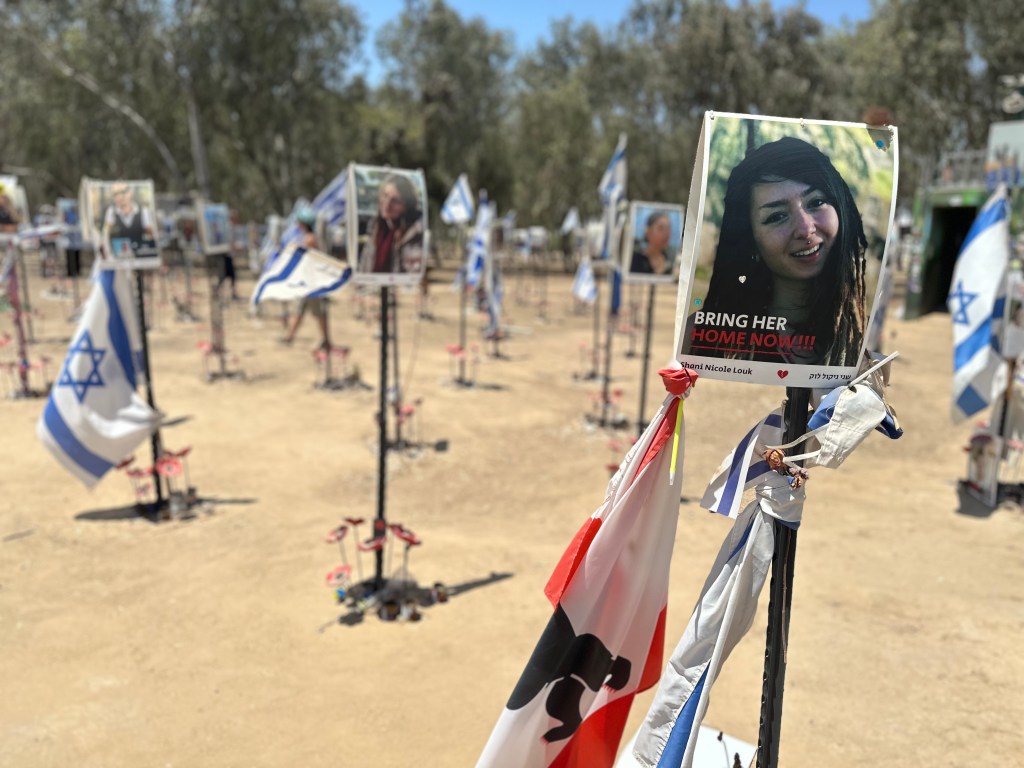
Standing on the site of the Tribe of Nova music festival in the Negev Desert about three miles from the Gaza Strip that was attacked by Hamas fighters the morning of October 7, Alon Penzel discussed with a group of international journalists his book collecting eyewitness testimonies of the day the 2023 Israel-Hamas war began.
“I tried to convey what I could to the international community,” Penzel, a 23-year-old gay man who used to be a spokesperson for the Israel Defense Forces and is now a second-year political science student at the University of Haifa, told the Bay Area Reporter during a recent press trip to the region.
“Every story here has been verified very carefully. What I haven’t verified is not in the book,” Penzel said, before going on to relate stories of beheadings and sexual violence.
At the festival, “there was a situation where a man tells about how he ran, from one tree to another, how he ran from tree to tree, got shot and still ran, and during the run he could see people get shot and fall.” Festivalgoers made fateful decisions whether they should “keep running, or try to help their friends and family members,” he said.
Penzel said he compiled “Testimonies Without Boundaries, Israel: October 7th 2023” after hearing conspiracy theories that the attacks didn’t target civilians.
He did concede some initial reports that spread on Israeli social media — such as 40 children allegedly beheaded by Hamas — turned out to be false.
“There is already denial, but this is our reality,” Penzel said. “Documenting that reality is extremely significant.”
At the music festival alone 364 civilians were killed, and at least 40 hostages were taken. A total of 1,139 people were killed by Hamas during that day’s incursion into Israel, including 764 civilians, and of the 251 taken hostage, 116 remain in captivity as of press time.
The war unleashed as a result of the attack has killed at least 39,000 Palestinians as Israel has conducted an extensive bombing campaign and a ground invasion of the Gaza Strip with the stated goal of destroying Hamas, which has governed the enclave — one of the two Palestinian territories, along with the West Bank — since 2007.
Israeli Prime Minister Benjamin Netanyahu’s office has stated the goal of the war is “the destruction of Hamas’ military and governmental capabilities.”
Penzel, citing October 7, agrees.
“We have a duty to protect our people,” he said. “We can’t let organizations who massacre just keep going.”
Differing opinions
But not everyone in Israel agrees that the destruction of Hamas is possible. Some are saying they’d accept a ceasefire if the hostages are returned. The Associated Press reported July 7 that protesters blocked highways on the nine-month anniversary of the massacre, demanding Netanyahu step down.
Gilad Korngold, whose son Tal Shoham is a hostage in Gaza, went so far as to tell reporters on the press trip that “I don’t care about Hamas.”
“The war must be stopped now,” he said. “There’s no price for our hostages.”
The June 23-27 trip the B.A.R. participated in was paid for by the American Middle East Press Association, a nonprofit that states it seeks to serve as “a trusted resource for journalists looking for experts and spokespeople on the current conflict and beyond.” AMEPA brought two American reporters on the press trip, “Wartime in Israel,” with its counterpart, the Europe Israel Press Association, which itself brought 22 journalists from the United Kingdom, Spain, Portugal, Italy, France, Norway, Belgium, the Netherlands, the Czech Republic, and Hungary. Neither organization is funded by the Israeli government, nor was there any pre-approval of interview questions, article topics, or requests to view articles before publication.
Hostage families speak out
The Hostages and Missing Families Forum works out of a skyscraper in Tel Aviv, a short walk from Hostages Square, where art installations, posters, handwritten notes, and even a mock tunnel meant to simulate those under Gaza where some of the hostages are believed to be held remember those in Hamas captivity. Ubiquitous stickers and posters on street signs, cars, homes, and businesses — as well as yellow ribbons on lapels — keep the hostage crisis front-of-mind for Israelis.
In the forum’s office, the international press met with Korngold along with Luis Har, who was kidnapped by Hamas from Kibbutz Nir Yitzhak and held hostage until his rescue after 129 days, and Dani Miran, the father of hostage Omri Miran.
The forum does not take a position on Israeli government policy in order to represent the widest number of hostage families, according to Daniel Shek, former Israeli ambassador to France and consulate general to the Pacific Northwest of the United States based in San Francisco.
“Wherever you stand on the Israeli-Palestinian conflict, what is happening here, the fact these people are abducted in Gaza is simply not right,” Shek said. “It’s simply not right. It’s a humanitarian issue that is universal. You can continue fighting for the Palestinians after this is made right.”
Shek translated for Har, who was speaking in Hebrew.
“The captors at the beginning were very aggressive and were tough, but there were different groups of captors with different roles,” Har said. “The guy who was with us in the place where we stayed the longest — the guy they called him the landlord — he told us we were abducted in order to exchange us for Palestinian prisoners.”
Har and the landlord developed almost a rapport until Har’s rescue by an IDF raid in February.
“The truth is he kept us safe even from his colleagues,” Har said. “The others were tougher, they were yelling at us not to come close to the window, silenced us, but he made sure it never went over to real violence. With him I had discussions, real conversations, but not with the others.”
Miran told the story of his son’s kidnapping by Hamas from Kibbutz Nahal Oz. Miran has three sons and a daughter; his son Omri is married with two daughters. He called October 7 “the darkest day of my life.”
“The distance between Nahal Oz and the border of Gaza is 700 meters, less than half a mile,” Miran said in Hebrew, speaking through a translator. “Around 6:30 in the morning on Saturday I opened the television and saw the red alert, which means missiles are coming into Israel. So I called my son, Omri, to ask how he and the family were because I usually worry when these things happen. And my son Omri said, ‘There are a few missiles. … Don’t worry.'”
Miran said he saw videos released by Hamas showing the carnage of that morning throughout southern Israel.
“I called my son again,” Miran said. “I said, ‘What is happening?’ and my son says, ‘I’m standing by the window and I see the whole kibbutz is full of terrorists.’ So Omri says he’s with his wife and two little girls in the safe room. He himself went to the kitchen to get two knives because he had no arms with him. That was the situation.”
Miran got the last text from his son around 11 a.m.
“What do you think I felt at that moment, when there was no answer from my son?” he asked. “I felt that moment when there was no answer from my son that everyone was killed. I had no control over my feelings.”
At 6 p.m. Miran got a call from the mother of his daughter-in-law, who lived in Sderot, another southern Israeli city. She said her daughter and the two girls were OK but Omri “was abducted and taken as a hostage to Gaza,” Miran recalled.
While he was grateful the rest of the family was alive, Miran said he asked himself “What am I going to see now with my son?”
All three agreed that the government’s aim should be the return of the remaining hostages.
“Hamas is an idea,” Korngold said. “Israel didn’t do anything about Hamas for 30 years. We have to say it and say it and say it.”
That sentiment repeats a statement made a few days prior by IDF spokesperson Daniel Hagari, who in a disagreement with the Netanyahu administration, said in an Israeli TV interview that, “Hamas is an idea. … it’s rooted in the hearts of the people — anyone who thinks we can eliminate Hamas is wrong.”
Ehud Yaari, senior Arab affairs commentator and analyst for Israel’s Channel 12 News, told the international reporters that Israeli troops don’t need to be on the ground in Gaza in perpetuity to prevent another October 7.
“The battle against Hamas will continue,” Yaari said about the day after. “Different intensity, different deployment, but we are going after them, and there is no debate between the opposition and Bibi [Netanyahu]. If a squadron pops up, they’ll get killed.”
With at least 60,000 Israelis still displaced in the north due to Hezbollah (which, like Hamas, is allied with Iran) rocket attacks from Lebanon since the October 7 attacks, the winding down of the Gaza operation may come sooner than later.
But Yaari said to expect that without a hostage deal. President Joe Biden and both Democratic presumptive presidential nominee Kamala Harris and Republican presidential nominee urged Netanyahu to take a hostage deal on the table during his U.S. visit last week.
“It’s up to Sinwar,” Yaari said, referring to Yahya Sinwar, the Hamas chief in Gaza. “It’s very clear if the Israelis get the hostages, they’ll eventually get to him.”
Asked about that scenario where all the hostages don’t get released, Korngold said, “It could happen. We have to start with something. If you say ‘no, no, no,’ I don’t care about Sinwar or Hamas. They have to do everything to release the hostages.”
Yaari characterized the war as Israel’s greatest crisis since independence, painting a picture of Hamas and Hezbollah waging a war of attrition (as opposed to an all-out attempt to destroy Israel) at the behest of Iran, which is fighting for dominance of the region against Saudi Arabia, and major non-NATO U.S. allies Egypt and Jordan.
Hezbollah, a Lebanese Shi’ite group, joins the Houthi movement in Yemen and various armed Shi’ite groups in Iraq and Syria, as well as Hamas in an “axis of resistance” to Israel and American interests in the Middle East, Reuters reports.
Israeli, US governments clash on settlements
Yaari was critical of the Netanyahu administration for allying with right-wingers and undercutting the judiciary’s independence. Among the right-wingers are National Security Minister Itamar Ben Gvir, who said he supported the “voluntary departure of the residents of Gaza.”
There have been no Israeli settlements in Gaza since the IDF’s unilateral withdrawal in 2005. But Israeli settlements in the West Bank are considered a major obstacle in the peace process and the establishment of an independent Palestine, and have been condemned by the U.S. and United Nations as violating international law.
The U.N. reported that over 500 people have been killed since October 7 by Israeli security forces and settlers. In February, Biden imposed sanctions on “persons undermining peace, security and stability in the West Bank.”
Amichai Chikli, Israel’s minister of diaspora affairs, doesn’t agree with the U.S. and international position on West Bank settlements, telling the international press unequivocally during a briefing in Jerusalem that “there is no future for a Palestinian state in Judea and Samaria,” referring to the West Bank.
“Judea is the core of the Jewish nation,” he said.
The B.A.R. asked Chikli how Israel can expect continued American support going forward as the countries’ disagreement on the matter widens.
“America,” he sighed. “We still have very good friends in the Democratic Party. You have congressmen such as Ritchie Torres [a gay, pro-Israel Democrat from New York] and others. They support a two-state solution, and I said I don’t have a problem with anyone who supports a two-state solution.”
Chikli continued that the two-state solution had been proposed several times to no avail.
“Maybe after 100 years, it’s time to rethink the two-state solution,” he said. “In America, we have very good friends in the Democratic Party. I hope we have bipartisan support. I don’t know about the future after what we saw on U.S. campuses.”
Since October 7, there’ve been thousands of arrests at over 50 schools that have seen demonstrations against Israel, as reported by Politico, in the most widespread campus unrest in five decades. Only one of three elite college presidents who recently testified before Congress still has a job after all three declined to say definitively if calling for the genocide of Jews violated their schools’ policies, an event referenced by Chikli as he continued his answer.
“I think that’s a big deal,” he said. “It’s too early to point out what’s going to happen.”
The B.A.R. directed the question back to the issue of settlements.
“I think it’s OK to have different opinions,” he said. “It depends on public opinion. Where is America headed? … It’s too early to make statements. We are in the event.”
Humanitarian crisis in Gaza
Returning to Tel Aviv from the Negev, Penzel discussed Israel’s efforts to address the humanitarian crisis in Gaza.
In addition to the 39,000 killed (Israel claims 14,000 of those were combatants), between 10,000 and 21,000 are missing, over 87,000 wounded, and 1.9 million (90% of the population) displaced. Over half of the dead are reportedly women and children.
There are significant shortages of every supply in Gaza — water, food, fuel, medicine, and medical supplies.
The World Health Organization “noted outbreaks of acute respiratory infections, scabies, lice, diarrhea, skin rash, chickenpox, and hepatitis associated jaundice,” according to a February report, which also showed over 1,000 patients in need of kidney dialysis, over 200,000 cases of acute respiratory infections, and over 152,734 cases of diarrhea. Over half the cases of diarrhea were in children under five — a rate that had risen 23 times in just two years.
“Since the beginning of the war, 35,000 trucks have carried humanitarian equipment into the Gaza Strip,” Penzel said June 25 (that number, according to a running total on an Israeli government website is now 38,870 as of July 8.)
Penzel said that 680,000 tons of “humanitarian equipment, including water, food, and medical supplies” were delivered (that number is now 734,475, according to the website as of July 8.)
There’ve been 130 airdrops containing 9,809 packages, according to the website. The countries leading in donations are Germany, Egypt, the United Arab Emirates, Belgium, Jordan, France, the U.S., the Netherlands and the U.K. CBS News reported five people were killed and 11 injured in March when an aid package’s parachute failed to deploy.
Penzel alleged that Hamas “steals the equipment” meant to go to the people of Gaza. Israel “takes care of its enemies people while being in jeopardy itself,” he said, conceding that “the international community doesn’t see it that way.”

 John Ferrannini