Richmond a flourishing enclave of SF’s Russian community

Holy Virgin Cathedral on Geary Boulevard — the largest of the six cathedrals of the Russian Orthodox Church outside of Russia — with its eye-catching onion domes is one of the anchors of the Russian community in San Francisco’s Richmond District. Photo by John Ferrannini.

This story first appeared in the Richmond Review on May 5, 2024:

One of many remnants of the Russian enclave on San Francisco’s west side serves sit-down meals every weekday.

Olga Medvedko, the executive director of Russian American Community Services (RACS) at 300 Anza St., said her organization has been serving meals to seniors and people with disabilities in San Francisco since 1977.

“We open our doors for nutritional services at 10:15 a.m. and start giving lunches to go about 10:45 a.m.,” Medvedco said. “People start coming and sit down for a lunch program, dine in, and at about noon we’re mostly done.”

Clients don’t have to be Russian-American to take part.

“The Russian speaking community is our target clientele, but we have people who enjoy Russian-style cuisine, and we try to be very friendly and hospitable,” she said. “We have staff coming from different places – the majority are bilingual. Some of them Ukrainian, some from Uzbekistan, Belarus, Serbia. We have Spanish-speaking staff too. It’s like a San Francisco mixture.”

But RACS provides more than just a bite to eat. It also uses the lunchtime to preserve ethnic traditions from the old country.

On Fridays, for example, the menu features fish due to the custom of the Orthodox Church to abjure meat that day.

Read more at richmondsunsetnews.com
Golden State queer mecca is more than just SF

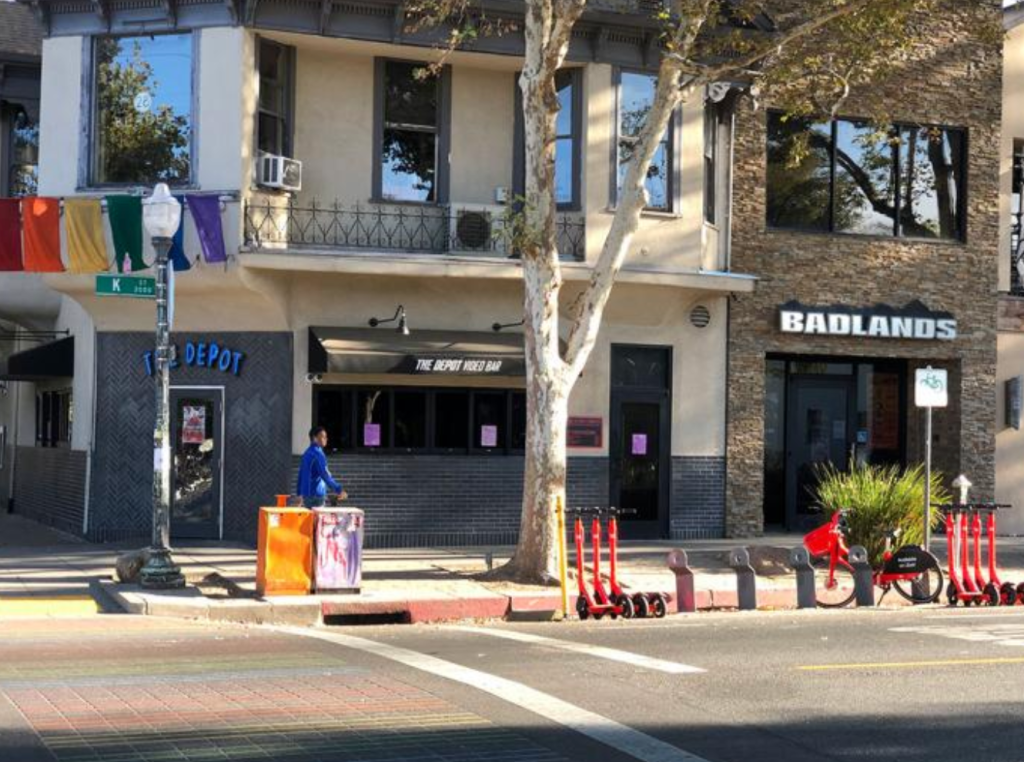
LGBTQ bars located on K Street in Sacramento’s Lavender Heights neighborhood include The Depot and Badlands. Photo: John Ferrannini

This story first appeared on ebar.com Oct. 18, 2023:

The 1979 police assault on San Francisco’s former Elephant Walk bar on Castro Street after the White Night riots was a defining moment for the LGBTQ neighborhood, helping to cement the solidarity of a new community while the whole world was watching.

Earlier that year, in February, there was another, less storied raid that helped connect another LGBTQ hamlet in California.

George Raya, 74, an LGBTQ activist who has lived in San Francisco, Sacramento, and San Diego, was in law school when he was visiting the Fourth Avenue Club, a gay bathhouse in San Diego’s Hillcrest LGBTQ neighborhood.

Police “sent in two teams of two people trying to get a gay person to solicit them,” Raya recalled to the Bay Area Reporter in a recent interview. “And I was watching them for a while that evening and they wanted you to make the first move. Right when I was going to tell the management, the lights went on. ‘Raid!'”

“They herded us all downstairs to a corner someplace,” Raya said. “Talk about being scared shitless.”

All told, 25 officers arrested 23 patrons, according to the San Diego LGBTQ Historic Context Statement, a 2016 document prepared for the city’s planning department.

“It ruined things for those people,” Raya said. “Some of them lost jobs.”

But Raya and others didn’t want to take the injustice lying down. They organized a meeting to address police harassment.

“The community really came together. Myself and the guy who was the head of the ACLU put together a community meeting, and out of that meeting the community went to the city council and lambasted the police department for wasting these resources on a victimless crime,” he said, referring to the American Civil Liberties Union.

The activists honed in on the issue of discrimination within the San Diego Police Department, and though an assistant police chief insisted that they didn’t discriminate on the basis of sexual orientation, tension between the department and the city’s LGBTQ community persisted for years, according to LGBTQ archives at San Diego State University.

The Fourth Avenue Club — now Club San Diego — is still standing, the last bathhouse in the city. But as the generation that created the heady days of gay liberation ages, it is stories like Raya’s that are at risk of being lost — the stories of how LGBTQ people found a home in the Golden State, and not just in the City-by-the-Bay.

Read more at ebar.com.

SF, beacon for queer tourists, battles bad perceptions

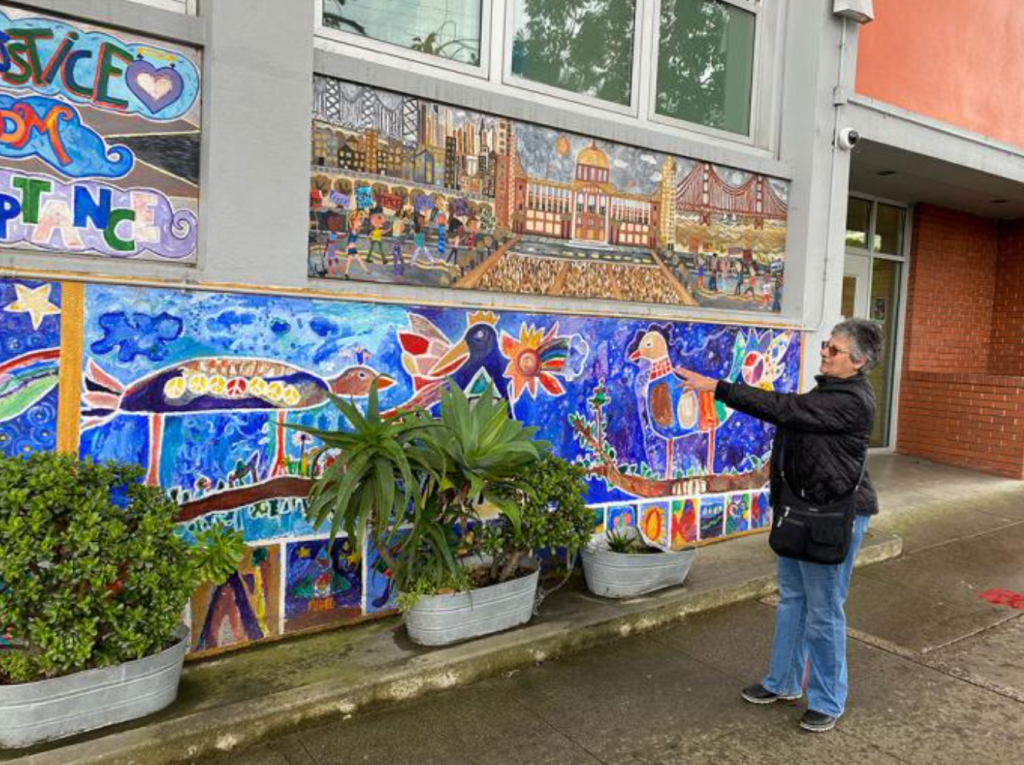
Kathy Amendola points to the murals at the Harvey Milk Civil Rights Academy during a recent Cruisin’ The Castro Walking Tours. Photo: John Ferrannini

They came from Russia, South Africa, Brazil, Japan, and Australia — on almost any given weekday at 10 a.m. they can be found at the rainbow flag pole at Castro and Market streets, ready for a two-hour walking tour of the crossroads of the queer world.

Or is it, still?

Kathy Amendola, a lesbian who has been running Cruisin’ The Castro Walking Tours for the past 18 years, told the Bay Area Reporter she will have to cut back on tours because of dangerous San Francisco street conditions.

“My tour members are appalled that outdoor drug use is acceptable,” Amendola said. “One member of my tour group said, ‘This would never happen in my city.’ It shouldn’t happen in any city.”

Amendola’s business is the city’s first and only legacy business tour company. Now, she’s announced she’s leaving the Castro Merchants Association for what she sees as a reluctance to be tough enough with the police and public officials.

“They have no vision of what we can be and it is frustrating for myself, knowing how great we can be, how we can be a heritage site,” Amendola said.

The news comes just as San Francisco works to restore its reputation, lowered by rampant property crime, open-air drug use and sales, and business woes. According to a report from the Institute of Governmental Studies released in the spring, downtown San Francisco ranked last among 62 North American cities in recovering from the COVID pandemic.

The pandemic exacerbated issues that had already been salient in the Castro neighborhood — particularly empty storefronts, onerous regulation, and blight. And while progress has been made on the latter two in recent years, even boosters of the city concede the needle has only moved so much.

The city that for decades was the gay Oz now asks how much more of its rainbow will fade.

Read more at ebar.com.

Gwen Araujo remembered 20 years after brutal murder

Trans teenager Gwen Araujo (file photo)

This story first appeared on ebar.com Sept. 28, 2022:

Sylvia Guerrero, whose transgender daughter was killed 20 years ago October 4, said, “If I had an LGBTQ child now, I’d still be worried, just as I was for Gwen at the time.”

“I was hoping the world would be a much better place for the LGBT community but it’s not,” Guerrero told the Bay Area Reporter. “It’s the world we live in, and it starts at home. Everyone deserves equality across the board.”

Guerrero’s daughter, Gwen Araujo, was 17 years old when, in 2002, she went to a house party in the East Bay city of Newark where she was beaten, tortured, and strangled by a group of young men — two of whom she reportedly had sex with — after they discovered she had male anatomy.

Guerrero said that at the time of the murder, “I had everything — a car, family, and 401K — and in one night my world forever changed and never has been the same.”

Beset by financial and health issues, Guerrero now lives in Tracy with one of her sons. She has a GoFundMe to help raise money for her expenses, saying that at 58 and having been outside of the workforce for so long, prospective employers often don’t get back to her.

Read more at ebar.com.

Longtime activist Cleve Jones to leave Castro after tense landlord dispute

Cleve Jones, right, shown at a 2021 rally in the Castro, will be moving from his longtime home Sunday. Photo: John Ferrannini

This story first appeared on ebar.com March 24, 2022:

Cleve Jones helped build the Castro. Now he’s leaving under what he wishes were better circumstances.

“I don’t want to leave,” the 67-year-old gay longtime activist — who worked with the late Harvey Milk and founded the AIDS Memorial quilt — told the Bay Area Reporter in a recent phone interview. “I came to the Castro in the mid-1970s, and I’ve moved away for work many times, but the Castro: that’s where my heart has always been.”

Jones said he isn’t leaving under circumstances he wants. Rather, he said he’s being forced out by a new landlord who doesn’t want him there.

“She literally and metaphorically has a sledgehammer over my head,” Jones said. “She’s already building around me.”

Jones said he wants to bring awareness to his situation not because he needs financial assistance — “I’m going to be fine,” he insisted — but for the benefit of fellow San Franciscans who may end up having no choice to leave when they and their landlords butt heads.

“I feel guilty,” Jones said. “I don’t have the stamina to hunker down and have months in a literal construction zone. She can do whatever she wants. … She bet she could get me out and she did.”

But true to form, Jones isn’t leaving the neighborhood without a protest, which will meet at Harvey Milk Plaza at 11 a.m. Sunday, March 27, then walk to Jones’ apartment on 18th Street near Diamond Street.

Read more at ebar.com.

A look back at Britney Spears’ Castro comeback that wasn’t

This story first appeared on KRON4.com Aug. 26, 2022:

SAN FRANCISCO (KRON) – Legendary pop star Britney Spears is back in the news today after dropping a duet with Elton John, “Hold Me Closer,” a spin on the pianist’s classic “Tiny Dancer.”

The single is certain to be in plenty of DJ sets tonight in the city, but what some may not remember was that San Francisco’s Castro neighborhood was to be the backdrop for the release of Spears’ seventh studio album, “Femme Fatale.”

So here’s the tea:

Read the rest here.

Mystery of the Golden Gate Bridge bricks solved

(Image courtesy of the Golden Gate Bridge Highway and Transportation Dist.)

This story first appeared on KRON4.com May 9, 2022:

SAN FRANCISCO (KRON) – After she was widowed at the age of 59, Vickie Good’s mother Lurana Hoetger would commute into San Francisco from Sausalito by ferry until she reached her 80s.

“She just loved the city,” Good told KRON4. So much so that when the Golden Gate Bridge turned 50 years old in 1987, she bought 16 bricks to be laid in a walkway of the bridge’s visitor gardens. The bricks cost between $32 and $75, though plaques in the walkway went for up to $1,000.

Good just learned the final fate of her mother’s brick — and the other 7,500.

“She loved her kids and grandkids and this was her legacy,” Good said. “She thought, ‘If I put bricks here, my kids and grandkids could come see me.’”

Read the rest here.

Calif., SF reviewing other vaccine for monkeypox

This story first appeared on KRON4.com Aug. 4, 2022:

SAN FRANCISCO (KRON) – As San Francisco health officials consider the use of a different vaccine to vaccinate people at risk of monkeypox, the California Department of Public Health confirmed to KRON4 that it has ordered 200 doses of the older jab — but declined to say why.

The news comes amid shortages of the Jynneos vaccine currently being used to fight the outbreak, which can only be produced by the Danish company Bavarian Nordic. It also comes after a scathing report in the New York Times alleged that there will be Jynneos shortages for the next few months because of a “hands-off” approach to the crisis from federal officials.

No jurisdiction in the country has used any other vaccine in this outbreak thus far, CDPH stated.

Read the rest here.

LGBTQ group to protest federal monkeypox response

(Graphic courtesy of the CDC)

This story first appeared on KRON4.com July 14, 2022:

SAN FRANCISCO (KRON) – At least one LGBTQ group is planning a demonstration outside the San Francisco office of the United States Department of Health and Human Services to demand the Biden administration “step up supply distribution of the monkeypox vaccine.”

The Alice B. Toklas LGBTQ Democratic Club is planning the protest for noontime Monday at the San Francisco Federal Building at 90 7th Street.

The move comes after local elected officials, gay community leaders and public health advocates blasted the federal government for its response to the outbreak, of which there are 68 confirmed cases in San Francisco as of early Thursday.

Read the rest here.

SF national parks ‘not safe,’ US police union says

This story first appeared on KRON4.com May 26, 2022:

SAN FRANCISCO (KRON) – The union representing the United States Park Police who patrol San Francisco’s national parks stated “families should avoid unnecessary travel to the Golden Gate National Recreation Area and the Presidio” — just days ahead of Memorial Day Weekend.

Kenneth Spencer, the chairman of the U.S. Park Police Fraternal Order of Police, stated May 24 in a press release that “with the Memorial Day holiday weekend here, millions of American families are putting the final touches on their summer vacation plans. It saddens me to say that those plans should not include visits to the Golden Gate National Recreation Area or the Presidio because, simply put, they are not safe.”

The statement is a very public surfacing of a labor dispute between the union and the National Park Service, which oversees the Golden Gate National Recreation Area. It also comes comes as concern about crime in San Francisco has become a topic of national concern, fueling next month’s recall election of District Attorney Chesa Boudin.

Read the rest here.