SF supervisors vote to OK Breed’s Tenderloin emergency declaration

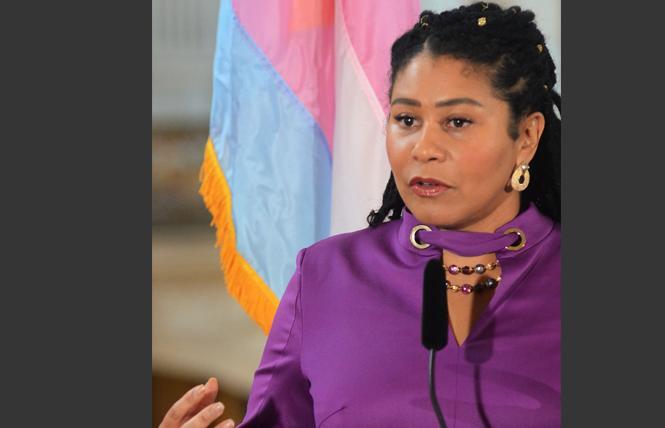
San Francisco Mayor London Breed’s emergency declaration for the Tenderloin was approved by the Board of Supervisors early December 24. Photo: Rick Gerharter  

This story first appeared on ebar.com Dec. 24, 2021:

The San Francisco Board of Supervisors voted early Thursday 8-2 to allow Mayor London Breed’s state of emergency in the Tenderloin to continue.

By law, the board had to convene a special meeting to continue the mayor’s emergency declaration within seven days of December 18, when it was announced. The meeting started at 2 p.m. December 23 and went past midnight as more than 100 people provided their one-minute each of public comment. The supervisors also debated the issue for several hours.

The emergency declaration allows the Breed administration to waive rules around contract procurement, as well as zoning and planning codes, to open a site where people with substance abuse issues can be linked to behavioral health services.

“The Tenderloin needs change, and that requires us to do things different,” Breed said in a statement shortly after the vote. Supervisor Aaron Peskin was absent, but sent a letter stating he would support the declaration. The supervisors are expected to discuss the matter again January 4.

Board President Shamann Walton and Supervisor Dean Preston voted against the measure.

Breed issued the emergency declaration last week.

“The situation in the Tenderloin is an emergency and it calls for an emergency response,” Breed stated at the time. “We showed during COVID that when we’re able to use an emergency declaration to cut through the bureaucracy and barriers that get in the way of decisive action, we can get things done and make real, tangible progress.”

The emergency declaration came in the days after Breed pledged to crack down on the “bullshit that has destroyed our city” by flooding the downtown neighborhood with police officers, which itself came on the heels of high-profile robberies of Union Square boutiques, heightened anxiety about public safety, and an ongoing overdose crisis that last year killed twice as many San Franciscans as died of COVID-19. Many of these overdose deaths are concentrated in the Tenderloin.

For more, go here.
Housing crisis takes toll on Bay Area LGBTQ seniors

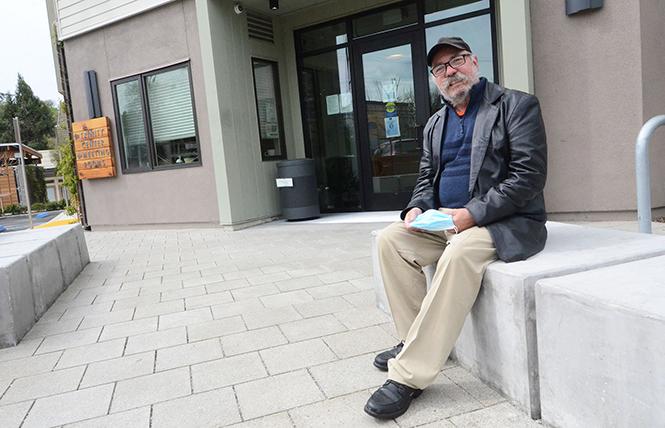
Charlie Uher sits in front of his apartment building in Walnut Creek. Photo: Rick Gerharter  

This story first appeared on ebar.com March 31, 2021:

Charlie Uher had never expected to be living out of his car.

The 67-year-old gay man told the Bay Area Reporter he had been living in a manufactured home in the East Bay community of Bay Point until a little more than three years ago.

“I had a dispute with the people who owned the land, so they kicked me out,” Uher said. “I bought the manufactured home because my mother passed and left me with some money. I thought that when I die they’d carry me out of there. … They gave me $4,000 for it, then turned around and sold it for $20,000.”

Uher, who hails from Chicago and lived for some time in San Francisco, parked on the streets in Bay Point for about two and a half years until he found housing at St. Paul’s Commons in Walnut Creek through the Trinity Center, which is a non-residential nonprofit serving working-class and homeless people in Walnut Creek and central Contra Costa County.

Uher, who said he’d been on the wait list since he lost the house, said he is lucky that he found housing before the onset of the COVID-19 pandemic last March; he’d been able to use a gym for showers, and various bathrooms around town during the time he’d been living in his vehicle.

After Uher got two jobs and had an increase in his income, he saw a substantial rent increase in February from the Housing Authority. Formerly paying $488 for his place, Uher has been paying $1,000 since January — and doesn’t know how much longer he can afford it, since he is paying most of his income in rent now that he no longer has the jobs.

For more, go here.

Experts fear a deluge of suicides due to COVID

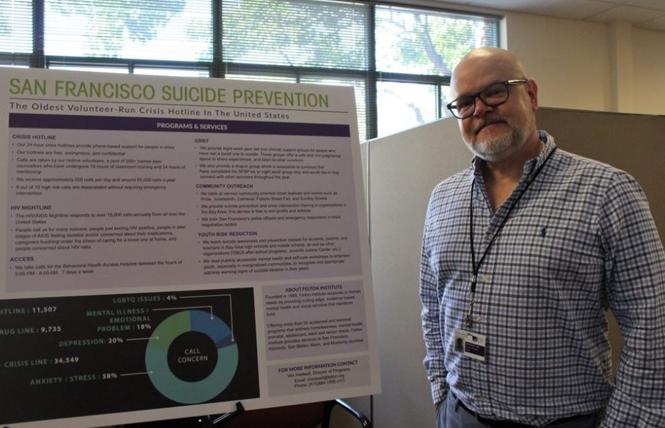
Van Hedwall is director of programs at San Francisco Suicide Prevention. Photo: Courtesy Felton Institute 

This story first appeared on ebar.com May 27, 2020:

A San Francisco Suicide Prevention report on the calls it receives shows that between the end of February and the beginning of April — as the novel coronavirus began to spread in the community, workers were laid off en mass, and small businesses shuttered — the number of medium- and high-risk calls increased by 60%.

Meanwhile Van Hedwall, a gay man who serves as SF Suicide Prevention’s director of programs, was hemorrhaging volunteers — the organization did not yet have a way to work from home after the city and surrounding counties issued a shelter-in-place order March 16.

“This is a pretty significant increase,” Hedwall said of the higher risk calls.

“We didn’t have a way for the call center to be remote until mid-April, so we were working in the office that first month of shelter-in-place,” Hedwall said in a phone interview with the Bay Area Reporter May 19. “Because of that our volunteer force of 150 fell off, so we were having to run the center with just staff.”

Volunteer rates have inched back up to about 80 people, Hedwall said, and after one of them connected SF Suicide Prevention with Cisco Systems they were able to start working from home — but that disruption (and the call center’s new ability to screen out prank calls) means that quantitative data on the number of calls per se is not the most accurate indicator of the stresses people are experiencing in the present crisis.

The categories of calls that have increased — those that are medium- and high-risk — require more work on the part of the volunteer counselors than offering encouraging words.

For more, go here.

Remembering Esta Noche as queer, POC spaces shutter

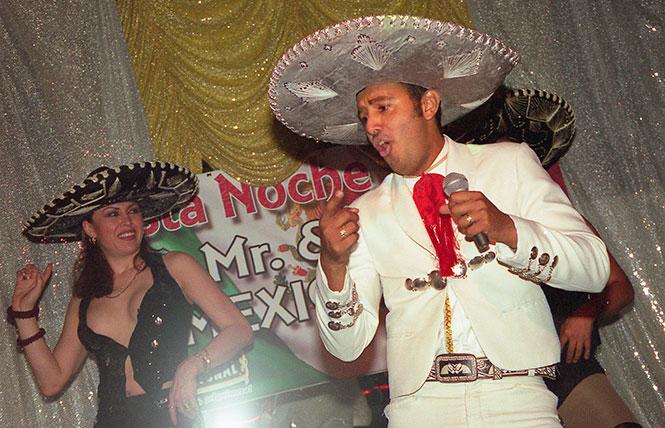
Mariachi performances were part of the entertainment offerings at Esta Noche, shown in this undated photo. Photo: Rick Gerharter

This story first appeared on ebar.com April 15, 2020:

Growing up, Anthony Lopez already knew something of the bar business — his parents owned two bars, one in San Leandro and one in Hayward.

“I used to do the inventory for them, so I had some experience with that,” Lopez said.

With that in mind, when he came to San Francisco during the heady 1970s, Lopez, a gay man, had an idea when he experienced discrimination in the newly emerging gay mecca.

“I used to go to the Castro and I didn’t like the vibration, the vibes,” Lopez said. “They were discriminatory. So, I said, ‘I think I’ll open my own bar,’ because I didn’t like the way I was treated.”

Lopez’s partner, in business and in life, is Manuel Quijano. Quijano, 59, who had come to the United States from El Salvador, said that it was hard to find a space where one could feel comfortable being both Latino and gay.

“At that time, Latinos were asked for two pieces of ID in the Castro in order to get in a bar,” Quijano said. “You couldn’t see gay people even in the Mission district. It was under a cloud. You couldn’t go in the streets and hold hands. It was horrible even to get a liquor license, let alone a permit for a place of entertainment.”

To read more, go here.

Loftus points to achievements as short DA tenure ends

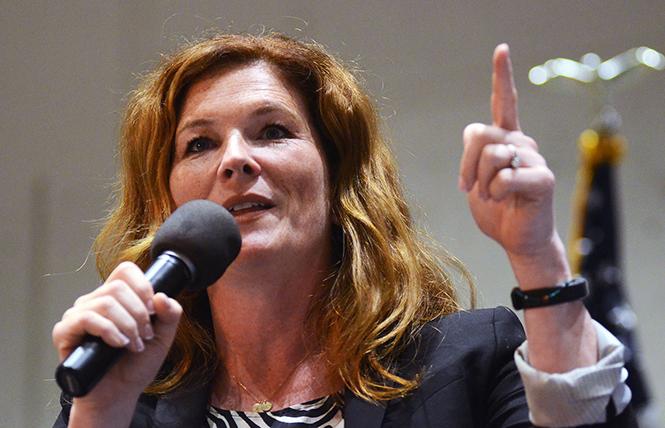
San Francisco interim District Attorney Suzy Loftus spoke at a campaign forum earlier this year. Photo: Rick Gerharter.

This story first appeared on ebar.com Dec. 30, 2019:

Suzy Loftus spent over a year campaigning to become San Francisco district attorney. She has held the job for a little over two months.

Yet during that time, Loftus announced the creation of an auto burglary task force, the discovery of $2 million in stolen property, and has boosted the morale of a law office that has seen a significant number of attorneys depart in recent years, she said in a wide-ranging interview with the Bay Area Reporter Thursday, December 19.

“Overall, I will say it is a tremendous honor to serve as the chief elected law enforcement officer for San Francisco for as many days as I get to do it,” Loftus said.

She will depart the office January 8, when District Attorney-elect Chesa Boudin is sworn in.

Loftus, who had been assistant chief legal counsel for the San Francisco Sheriff’s Department, announced her candidacy for district attorney in the summer of 2018 before then-District Attorney George Gascón announced he wasn’t seeking re-election.

Loftus framed herself as a progressive prosecutor who could deliver results for victims and reduce recidivism among defendants, cutting through the city’s often-labyrinthine criminal justice system.


To read more, go here.

California lawmakers focus on CSU costs following tuition hike

This story first appeared on statehornet.com on April 27, 2017.

silva
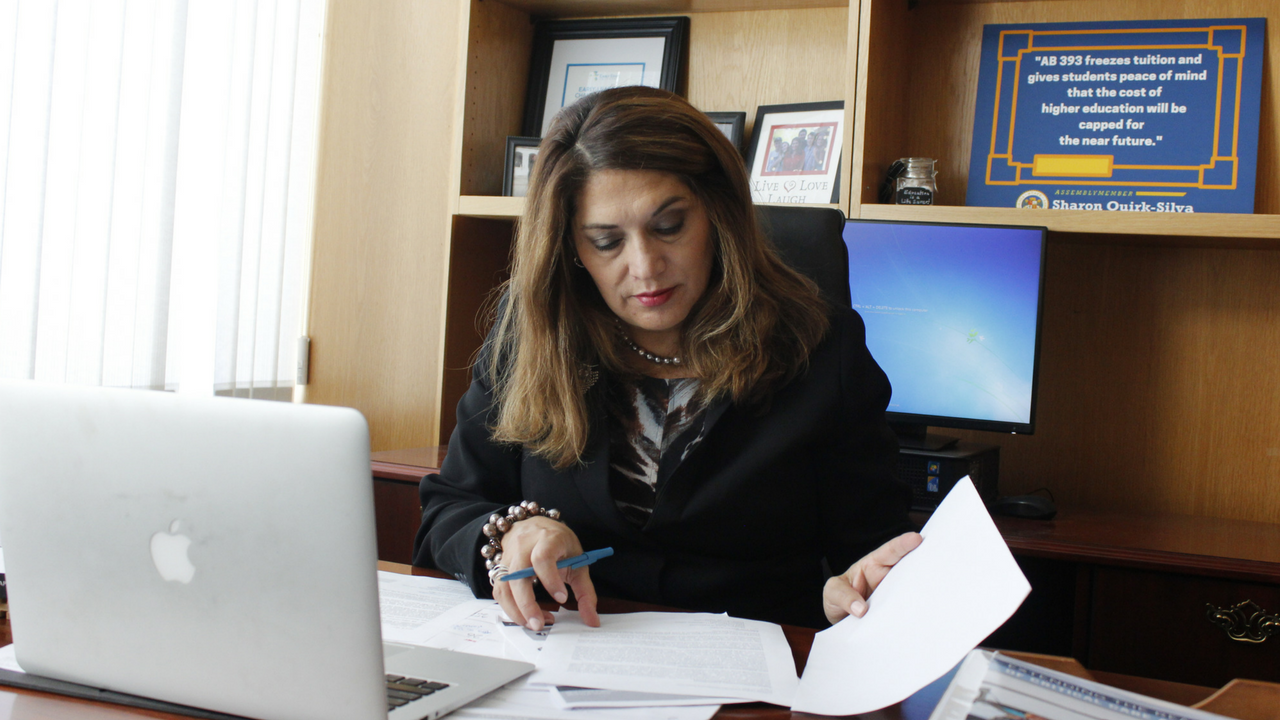
Assemblywoman Sharon Quirk-Silva, D-Fullerton, pictured in her office in the California State Capitol in Sacramento on April 19. Quirk-Silva introduced Assembly Bill 393, which would freeze tuition at all three systems of higher education in the state through the 2019-2020 academic year. (Photo by John Ferrannini)

As students and faculty lobby the Legislature to fully fund the California State University’s budget for the upcoming academic year after the Board of Trustees approved a tuition increase, some lawmakers have prioritized other proposals aimed at lowering college costs.

The California State University Board of Trustees passed the first tuition increase in six years on March 22 with the proviso that it will not go into effect if the Legislature fills a $168 million shortfall between the CSU’s and Gov. Jerry Brown’s budget proposals.

Ryan Brown, a Sacramento State student and the vice president of legislative affairs at the California State Student Association, has joined Sac State professorChristine Miller, the chair of the CSU Academic Senate, in visiting the Capitol to persuade legislators to do just that when it votes on the state budget.

“The governor is being very fiscally conservative this year and is really the biggest obstacle,” Brown said. “I’m not incredibly optimistic that the Legislature will come through.”

Brown said that the trustees, some of whom said they did not want to raise tuition but felt they had no other choice, have not been proactive in trying to prevent the increase from taking effect.

“They haven’t been in the Capitol with students or publicizing any actions they’ve taken to push for full funding,” Brown said. “(It) seems to me that the justification for the increase is that it would put pressure on the governor — but part of that has to be the trustees putting that pressure on themselves.”

Sacramento State alumnus and Assemblyman Kevin McCarty, D-Sacramento, said that he didn’t support the tuition increase, but that the Legislature’s move will depend on how much money the state received from taxes this spring.

“Obviously, we’d support that if there was an unlimited pot of money but we have to evaluate how much money we have and live within our means,” McCarty said in an interview with The State Hornet.

To read more, go here.

Meet the man who sued Sac State for right to form an official LGBT club on campus — and won

raya
Sacramento State alumnus George Raya stands in front of the Capitol in downtown Sacramento, where he successfully lobbied for the repeal of laws banning ‘sodomy’ and ‘oral copulation.’ (Photo by John Ferrannini)

This story first appeared on statehornet.com on April 12, 2017.

When George Raya requested that the Society for Homosexual Freedom be recognized as an official Sacramento State club in 1970, school officials were uneasy about Associated Students, Inc. granting club status to a group they called “deviants.”

“The police called us ‘unapprehended felons’ — it was against the law to do homosexual acts,” Raya said. “The priests said we were going to hell, that we were sinners. The American Psychological Association said we had a mental illness. So things were rough back in those days.”

Raya, who was serving on Sac State’s student senate, had come out of the closet one year earlier at the age of 19 and was an early member of SHF, a club that included both gay and straight students who wanted to learn more about the LGBT community.

The inspiration for SHF was a similar group at UC Davis known only as C7 — the name of the classroom in which it met.

Martin Rodgers, a psychology professor at Sac State, was called in by the UC Davis administration to investigate if C7 members were in need of counseling.

“Marty went back to the administration and said ‘There’s nothing wrong with them, they’re very happy people (and) well-adjusted,’ ” Raya said. “The only thing, of course, is they’re homosexual.”

Rodgers felt that a similar club for Sac State students would be a good idea, and the first meeting was held in his apartment.

“Every time someone knocked on the door or rang the doorbell, we kind of stiffened a bit because we didn’t know if it was another person coming to attend or if it was the police coming to arrest us,” Raya said.

When Raya proposed that SHF be recognized by Associated Students, Inc., Otto Butz — the acting president of the college — shot down the idea, refusing to approve the group’s charter.

“He wanted to become the permanent president and he felt that if he granted us a charter, (then-Governor) Ronald Reagan wouldn’t like approving a gay student group,” Raya said.

So ASI filed a lawsuit against both Sac State and the Cal State trustees.

Sac State and the trustees argued that an LGBT club shouldn’t be approved because it would promote what were then illegal sexual acts.

Judge William Gallagher decided the case on Feb. 9, 1971 in favor of ASI, declaring that the school had to recognize SHF because of protections for freedom of speech and assembly in the First Amendment to the Constitution.

“The judge said ‘Look, you can’t deny them based on what you think they will do, they have to have actually done something,’ ” Raya said. “That case was used by other campus groups around the state and country. If they got denied they’d go to their president and say ‘Look, you lost in Sacramento, you’re not going to win here.’ ”

That spring, Sac State held a symposium on the topic of homosexuality headlined by none other than Beat poet Allen Ginsberg.

For more, go here.

2017: A political tragedy

Cover-900x681
(Photo illustration by Pierce Grohosky)

This story first appeared on statehornet.com on Feb. 23, 2017.

Since the election, Sacramento State has been experiencing a very high amount of political activism on both sides of the spectrum — and the tension has no sign of letting up anytime soon.

In fact, each passing day of Donald Trump’s presidency has seen more and more pronounced, heightened emotions: anxiety and rage, disgust and self-righteousness, hope and pity.

How did we get here? And what’s next for a campus on the edge?

Just four months ago, it was a good time to be on the left.

Hillary Clinton’s presidential campaign did not exactly inspire the way Barack Obama’s did eight years earlier, but the surprising insurgency of Bernie Sanders in the Democratic primary removed the stigma from politically identifying as a socialist, and the Obama administration was pushing once undreamed-of initiatives like the recognition of Cuba and transgender rights.

And it looked like in spite of the rise of alternative left-wing parties, even Clinton would slide to an easy victory over Donald Trump — demonstrating that if the Republican Party were to move forward, it would have to reject the forces of reaction and reach out to Latinos, blacks, gays and other minority groups.

For Estevan Hernandez, a Sac State alumnus and member of the Peace and Freedom Party State Central Committee, it looked like all the political energy awakened in 2016 was going to change the American status quo.

“Today we have the Black Lives Matter movement, and we have Standing Rock, and now we have (Colin) Kaepernick refusing to abide by that national anthem,” he said in an Oct. 4 interview at a campus event featuring Peace and Freedom vice presidential candidate Dennis Banks. “There’s an alternative to capitalism. We don’t have to go to the two same old things over and over and over again.”

For more, go here.

Sac State students, faculty protest Trump inauguration

IMG_7859_WEB
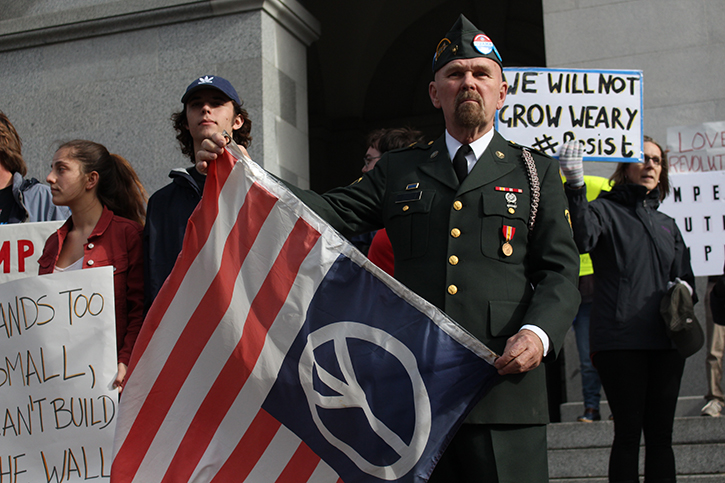
Jeff Peck, who said he served in the U.S. Military from 1966 to 1968, holds an American flag with a peace sign substituted for the stars in the left-hand corner. Peck said he thought it was ‘important that people stand up and show that this is not normal.’ (Photo by Barbara Harvey)

This story first appeared on statehornet.com on Jan. 20, 2017:

Hundreds of young people — including Sacramento State students and a professor — marched on downtown Sacramento on Friday afternoon in protest of the inauguration of Donald Trump as the 45th president of the United States.

Linda Ann, a Sac State student and the co-chair of the Democratic Socialists of America, helped to organize the ‘January 20th Day of Action.’

“We hope to achieve, one, sending Donald Trump a message that we’re not just going to stand by as he destroys our community and our country,” Ann said. “We hope to gather support for local efforts here in Sacramento to kind of pad our city and make sure that the negative effects of his presidency are going to affect our community a little bit less.”

The event began at noon with protesters gathering in four locations around Sacramento and converging on the West Steps of the State Capitol around 2 p.m.

The demonstrators chanted slogans such as “Not my president” and “No Trump, No KKK, No fascist USA,” which have been heard at similar protests around the country in the wake of the controversial billionaire’s surprise victory in the presidential election two months ago.

Sac State professor Kathy Martinez attended the protest with her two dogs, Osi and Kona, both adorned with signs reading “not my POTUS.” Martinez echoed the sentiments of many demonstrators, who said that they were concerned with the rhetoric, character and policy proposals of the new president.

“Everything that Trump stands for, I am opposed to,” Martinez said. “I can’t begin to state the discontent I have. He did not legitimately win, he is not qualified, and so many of his policies are going to be a catastrophe.”

For more, go here.

Michael Brown Sr. speaks to crowded University Union Ballroom

This story first appeared on statehornet.com on Oct. 21, 2016:

“I went to a place you probably would never, ever see.”

Michael Brown Sr. said that’s all he can remember about the moment when he found out that his son, Michael Brown Jr., had been killed by Ferguson, Missouri police officer Darren Wilson on Aug. 9, 2014.

“I felt like I went in a tunnel because I was shocked when I got the call and from right then and on I couldn’t remember nothing,” he said.

Brown spoke about his son’s death — which shook the conscience of America and brought the Black Lives Matter movement to worldwide attention — at a lecture in Sacramento State’s University Union on Thursday.

Brown is touring colleges nationwide to bring attention to the Michael Brown Chosen For Change Foundation, which Brown said seeks to help struggling families.

“The reason we have our foundation is supporting families and supporting black families, supporting children, just building homes and building our communities back up,” Brown said. “Trying to love one another. We are lacking in that.”

On Aug. 9, 2014, Officer Darren Wilson encountered Michael Brown Jr. and a friend, noticing that the two fit the descriptions of suspects in a convenience store robbery earlier that day.

According to a 2015 report from the U.S. Department of Justice, a physical altercation took place between Brown and Wilson in which Brown attempted to grab Wilson’s firearm.

For more, go here.